

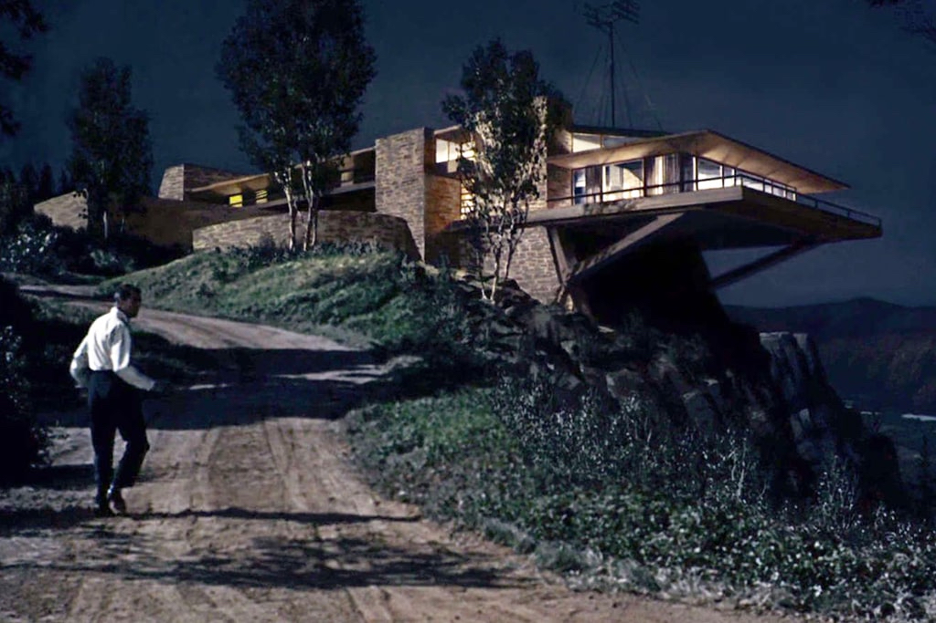
In high-elevation architecture, few feats are more captivating than those that flirt with the edge—literally. Structures built into cliffs and mountains create a visceral sense of suspension. They blur the boundary between human ingenuity and the natural world’s extremes. For mountain homeowners, lake enthusiasts, and coastal dwellers who appreciate breathtaking topography and bold design, these sites offer rare examples of architecture. They embrace danger, drama, and elevation. Whether carved into seaside cliffs or perched above deep alpine valleys, each structure strikes a balance between innovation and context. This yields spaces that enhance their surroundings rather than dominate them.
This list highlights seven of the most striking cliffside structures around the world. Each one evokes a sense of vertigo, awe, and daring. These seven standout projects exemplify architectural boldness, environmental sensitivity, and a deep respect for dramatic topography.
The Cliff House – Nova Scotia, Canada
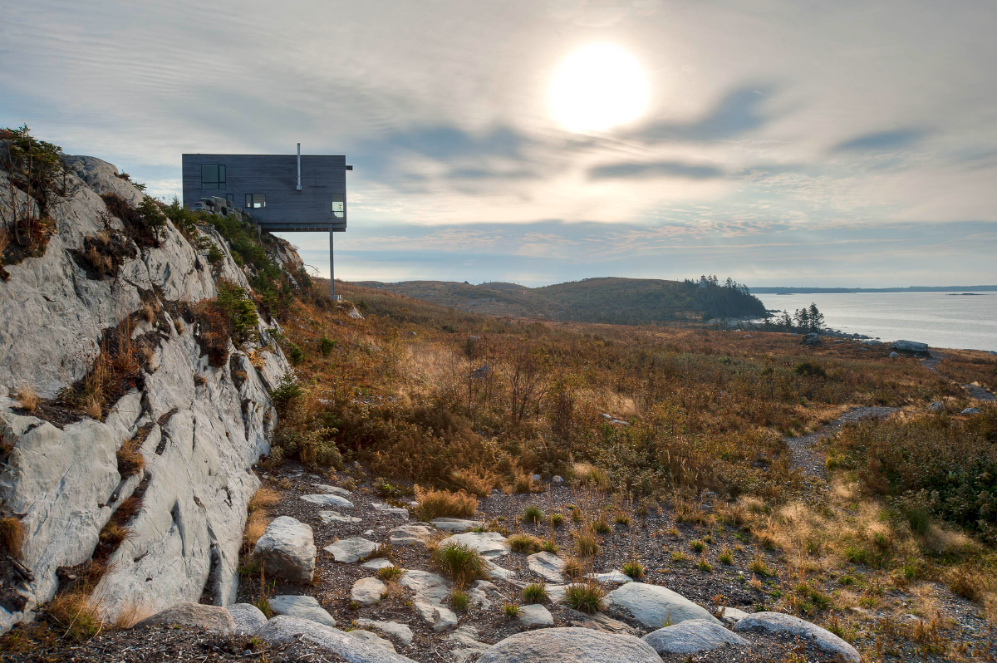
Poised dramatically over the Atlantic on the windswept cliffs of Nova Scotia, the Cliff House by MacKay-Lyons Sweetapple Architects is both poetic and practical. Anchored by steel stilts into the rocky coastline, this minimalist retreat serves as a writer’s cabin and lookout point. Its linear silhouette and modest scale contrast sharply with the rugged terrain. Yet, the structure’s clean lines and cedar cladding echo the elemental simplicity of its setting. The house opens entirely on one end, allowing uninterrupted views of ocean swells and stormy skies. Designed for quietude and reflection, it proves that cliffside architecture can be both bold and contemplative.
Hanging Temple – Datong, China
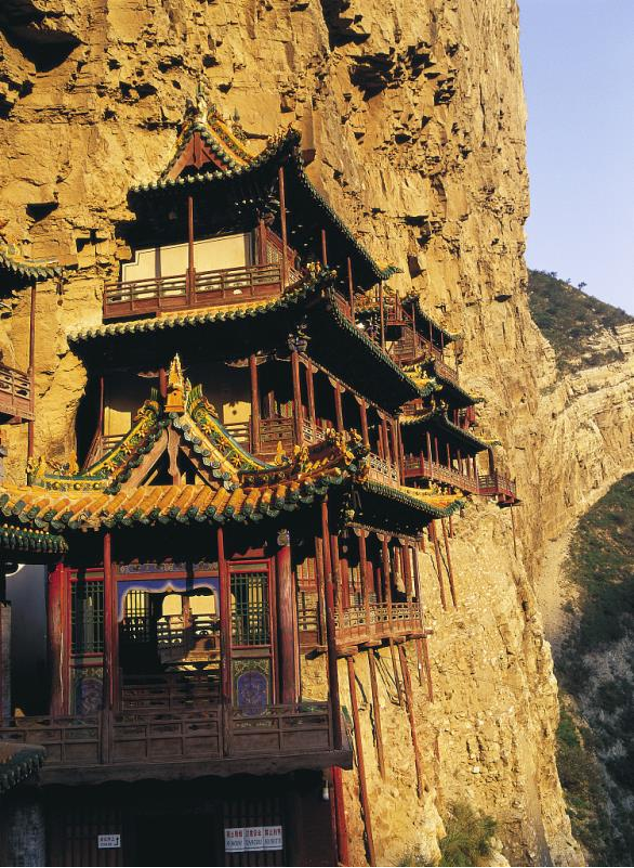
Perched precariously on the cliffs of Mount Heng in Shanxi Province, the Hanging Temple is a 1,500-year-old architectural marvel. Built directly into a vertical rock face, the wooden temple seems to float in midair, supported only by long oak beams embedded into the cliff. Constructed during the Northern Wei Dynasty, it uniquely blends elements of Buddhism, Taoism, and Confucianism—a rare spiritual synthesis. The temple’s endurance over centuries, despite earthquakes and erosion, underscores the ingenuity of ancient Chinese engineering. Beyond its religious purpose, the Hanging Temple is a master class in adapting to vertical space with grace and stability. Legend has it that a monk named Liao Ran constructed this wonder of the world in the late 5th century AD.
Knapphullet – Sandefjord, Norway
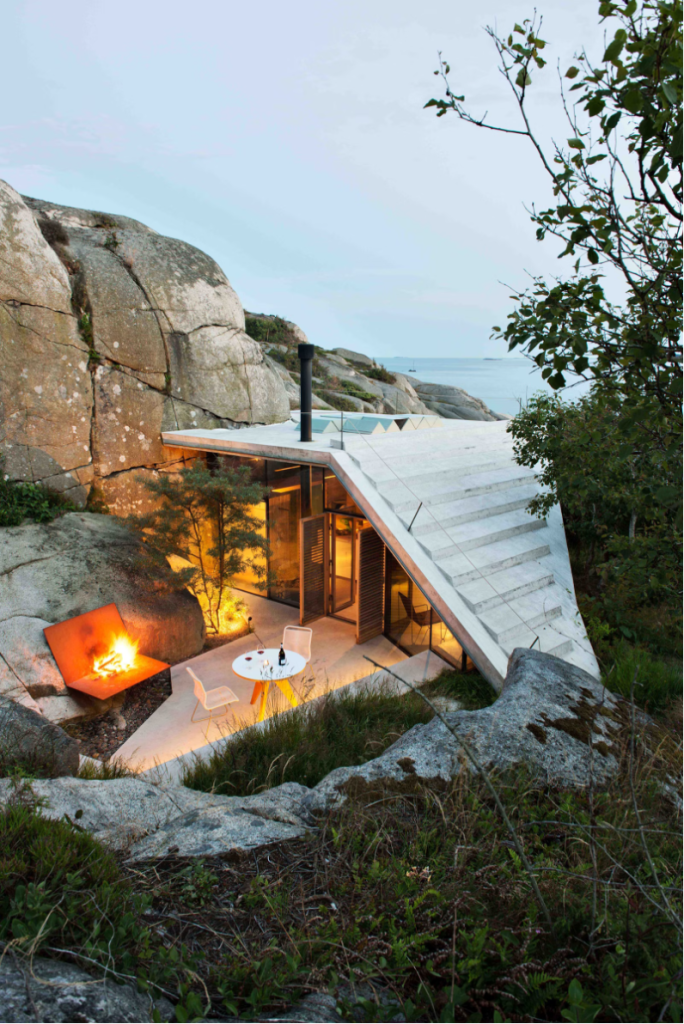
Tucked into the rocky coastline of Sandefjord, Norway, Knapphullet is a compact cliffside retreat designed by Lundhagem Architects. The structure nestles beneath a massive overhanging boulder and anchors directly into bedrock just meters from the sea. Designed as a guesthouse and retreat, it makes daring use of a tight and topographically complex site. A sweeping curved concrete roof echoes the surrounding geology, while expansive glass walls open the small interior to wind, sky, and surf. With no railing on its exposed edge and a footprint that almost disappears into the rock, Knapphullet creates a powerful sense of immersion in the coastal environment, suspended between land and sea, weight and lightness.
Mirador House – Tunquén, Valparaíso Region, Chile
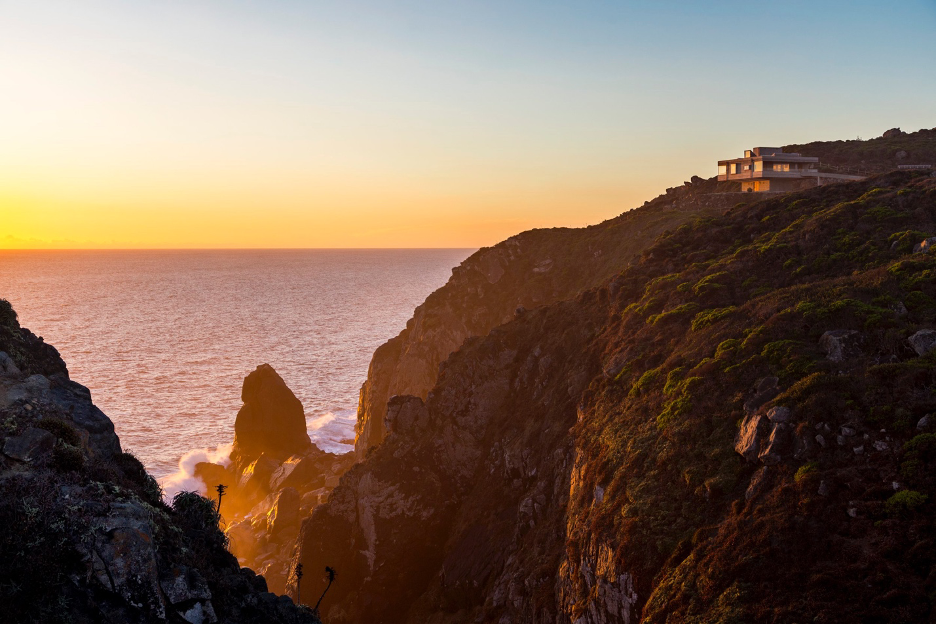
Designed by Victor Gubbins Browne of Gubbins Polidura Arquitectos and completed in 2015, Mirador House dramatically perches above the cliffs of Punta del Gallo in Tunquén, along Chile’s rugged Pacific coastline. From its narrow base, the main concrete volume cantilevers outward in both directions. This creates twin terraces that face the sea and the inland hills. The structure appears to float above the terrain, giving the illusion of weightlessness despite its raw concrete shell.
A ramp leads up to the home’s central double-height space. This space is anchored by a sculptural spiral staircase ascending to the rooftop terrace. The house illustrates a study in contrasts—its brutalist material palette softened by light and sweeping views. Its modernist lineage, a nod to Le Corbusier’s Villa Savoye, is reinterpreted through a distinctly Chilean coastal lens. The result is a gravity-defying retreat that hovers at the edge of the earth. It is rooted in the cliff yet oriented toward the horizon.
Mirage House – Tinos Island, Greece
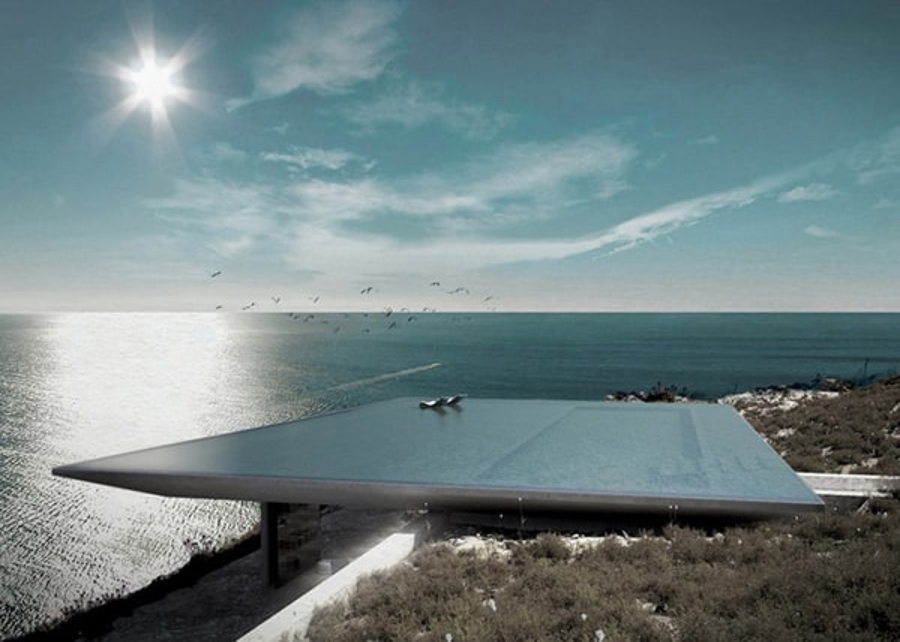
Though it appears to disappear into its cliffside, the Mirage House by Kois Associated Architects is one of the Aegean’s most visually striking homes. Built into a rocky slope on Tinos Island, the residence is completely embedded in the earth, with only a long infinity pool at roof level visible from above. This pool reflects the sky so precisely that the house seems to vanish, hence the name. From below, however, the structure reveals itself: sharp concrete lines cut into the cliff face, and expansive glazing opens to unobstructed views of the sea. This inversion—hidden from the top, exposed from below—creates an architectural illusion of floating between land and sky.
Amangiri Resort – Canyon Point, Utah
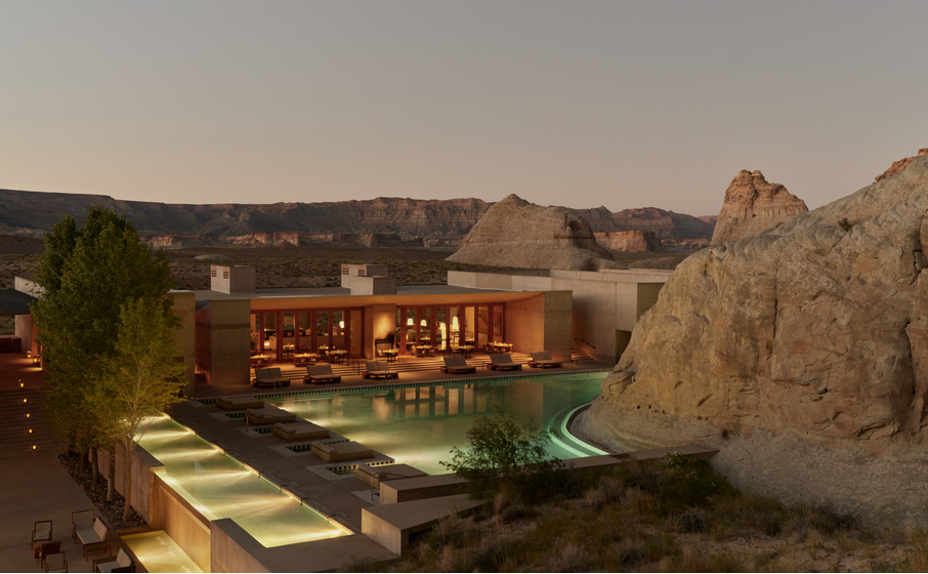
Tucked into the striated sandstone canyons of southern Utah, Amangiri is one of the most iconic desert-mountain resorts in the world. Designed by architects Marwan Al-Sayed, Wendell Burnette, and Rick Joy, the ultra-luxury resort seamlessly blends with the surrounding mesas and washes. Rather than dominate the landscape, the concrete structure mirrors its tones and textures. The spa, suites, and pool are sculpted around natural rock formations, often incorporating them into the walls themselves. Amangiri’s minimalism allows the stark grandeur of the Colorado Plateau to take center stage, offering guests a rare intimacy with the land. It’s a unique property that feels excavated more than built.
Berggasthaus Aescher – Alpstein, Appenzell Innerrhoden, Switzerland
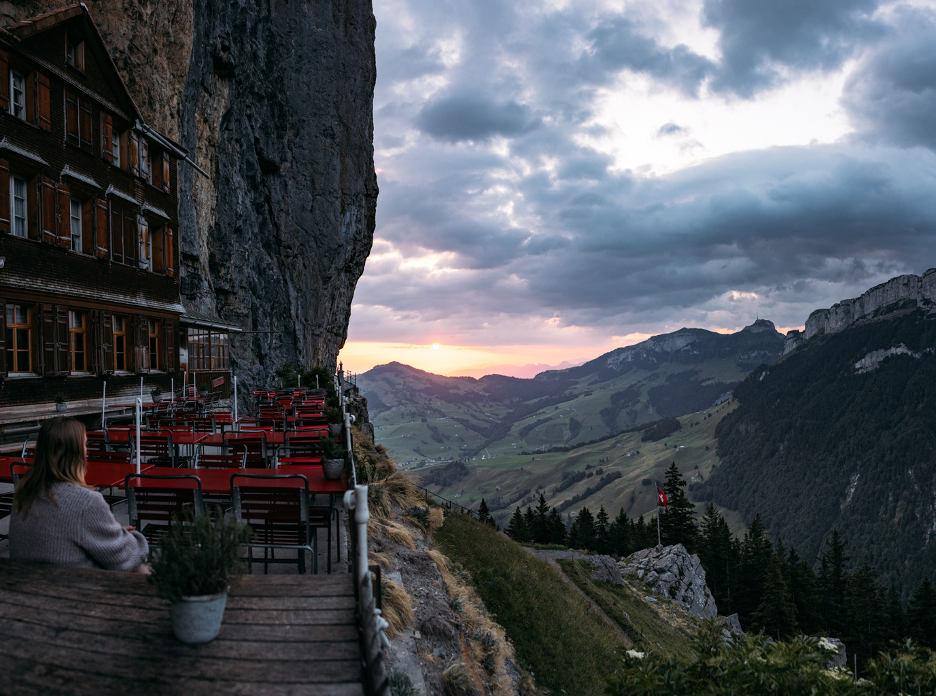
Clinging to a vertical rock face in the Alpstein mountains of northeastern Switzerland, Berggasthaus Aescher is one of the most improbable mountain lodges in the world. Originally constructed in 1884, the structure was built by local craftsmen into a natural recess below the Wildkirchli caves to serve pilgrims and hikers visiting the nearby chapel and hermit’s dwelling. Though not designed by any known architect, its vernacular Alpine construction—wooden walls anchored directly into the cliff—demonstrates an intuitive understanding of both site and survival.
The guesthouse gained global recognition after appearing on the cover of National Geographic Traveler, and today, it remains accessible only via a cable car to Ebenalp, followed by a short, vertigo-inducing hike. After careful renovations completed in 2021, Aescher once again welcomes overnight guests during the summer and early fall. Accommodations remain spartan—no showers or central heating—but the reward is waking up suspended between stone and sky, with nothing but the sheer drop of the Appenzell Alps below. Aescher’s appeal lies not in architectural innovation but in its poetic resilience—an enduring structure nestled in the cliff, defying gravity through simplicity, heritage, and alpine tenacity.
These marvels of high-elevation architecture aren’t just feats of design—they’re provocations. Each one dares to defy gravity, clinging to cliffs, diving into voids, or hovering above landscapes with minimal visible support. In doing so, they sharpen our perception of space, risk, and scale. For those drawn to the mountains and cliffs not just for scenery but for the sensation of being on the edge, these buildings offer something more: a tangible expression of elevation as a way of living, not just a place to build. For more on living your best mountain life, visit Mountain Homes Lifestyles.